Calisthenics Workout Plan: A Comprehensive Guide
Embark on a transformative fitness journey with this detailed plan‚ designed to sculpt strength and endurance using only your bodyweight‚ readily available!
Calisthenics‚ derived from the Greek words kalos (beauty) and sthenos (strength)‚ is a form of exercise consisting of a variety of movements – often rhythmic – typically using minimal equipment. It’s a truly accessible fitness discipline‚ relying on your own bodyweight for resistance. Think push-ups‚ squats‚ planks‚ and pull-ups – movements many of us performed as children on the playground!
Historically‚ calisthenics has been a cornerstone of military training and athletic conditioning. However‚ its benefits extend far beyond these realms. It’s a fantastic way to build functional strength‚ improve flexibility‚ enhance coordination‚ and boost overall physical fitness. This guide will provide a structured approach to calisthenics‚ suitable for all levels‚ from complete beginners to seasoned athletes. Prepare to unlock your body’s potential!
What are the Benefits of Calisthenics?
Calisthenics offers a wealth of advantages‚ extending beyond mere physical strength. Because it utilizes bodyweight‚ it builds functional strength – the kind of strength used in everyday activities. This translates to improved posture‚ balance‚ and coordination. Unlike weightlifting‚ calisthenics often emphasizes a greater range of motion‚ enhancing flexibility and reducing the risk of injury.
Furthermore‚ it’s incredibly accessible; no gym membership or expensive equipment is required! You can perform calisthenics anywhere‚ anytime. It’s also highly scalable‚ meaning exercises can be modified to suit any fitness level. Beyond the physical‚ calisthenics can boost mental well-being‚ reducing stress and improving mood. It’s a holistic approach to fitness‚ promoting overall health and vitality.
Calisthenics vs. Weightlifting: A Comparison
Both calisthenics and weightlifting are effective methods for building strength‚ but they differ in approach. Weightlifting primarily focuses on maximizing force production‚ often leading to greater muscle hypertrophy – increased muscle size. It relies on external resistance to overload muscles. Calisthenics‚ conversely‚ emphasizes relative strength – strength relative to one’s bodyweight.
This means calisthenics builds a more usable‚ functional strength. Weightlifting can be more isolating‚ targeting specific muscle groups‚ while calisthenics often involves compound movements‚ working multiple muscle groups simultaneously. Cost is another factor; weightlifting requires equipment‚ while calisthenics needs minimal to none. Injury risk also varies; improper weightlifting form can lead to injury‚ while calisthenics generally has a lower risk‚ focusing on controlled movements.

Building Your Calisthenics Foundation
Establishing a solid base is crucial for progress; mastering fundamental movements and proper form prevents injury and maximizes results consistently.
Warm-up Routine (5-10 Minutes)
Prior to each calisthenics session‚ a dynamic warm-up is essential to prepare your muscles and joints for the upcoming exertion. Begin with 5 minutes of light cardio‚ such as jogging in place or jumping jacks‚ to elevate your heart rate and increase blood flow.
Follow this with dynamic stretches‚ focusing on movements that mimic the exercises you’ll be performing. Include arm circles (forward and backward)‚ leg swings (forward‚ backward‚ and sideways)‚ torso twists‚ and high knees.
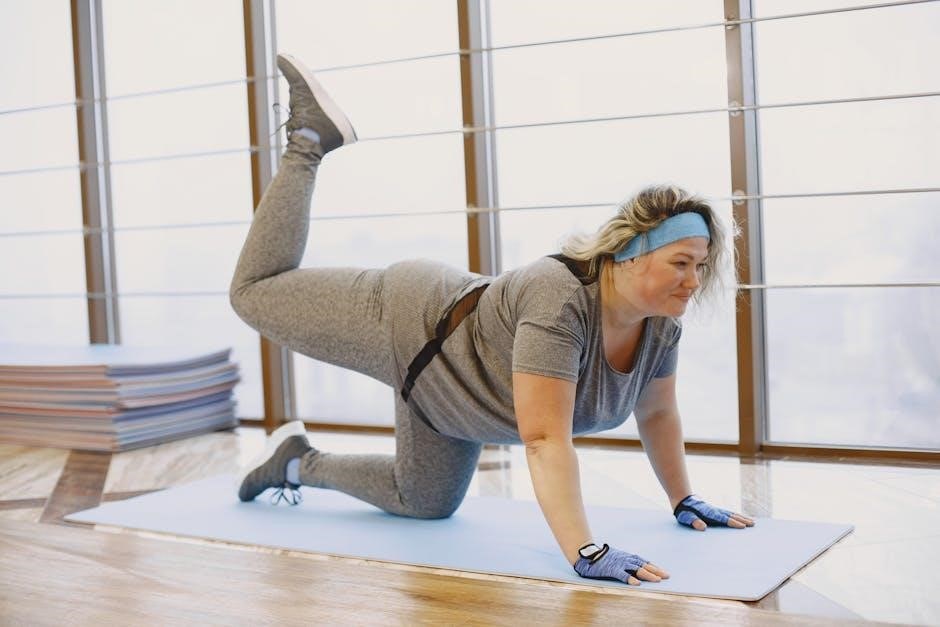
Specifically‚ perform 10-15 repetitions of each stretch. Don’t forget wrist rotations and ankle rotations to improve mobility in those areas. A proper warm-up significantly reduces the risk of injury and enhances performance‚ allowing you to get the most out of your workout. Remember to listen to your body and adjust the intensity as needed.
Mastering the Fundamental Movements
Calisthenics hinges on a solid foundation of fundamental movements. Before progressing to advanced skills‚ prioritize perfecting the basics. These movements – push-ups‚ squats‚ and planks – form the cornerstone of nearly every calisthenics routine.
Focus on proper form over quantity. Incorrect form can lead to injuries and hinder progress. Take the time to understand the biomechanics of each exercise and practice consistently.
Initially‚ you may need to modify these movements to suit your current fitness level. For example‚ start with knee push-ups or assisted squats. As your strength increases‚ gradually progress to more challenging variations. Consistency and mindful practice are key to building a strong and sustainable calisthenics practice.
Push-Ups: Variations and Progression
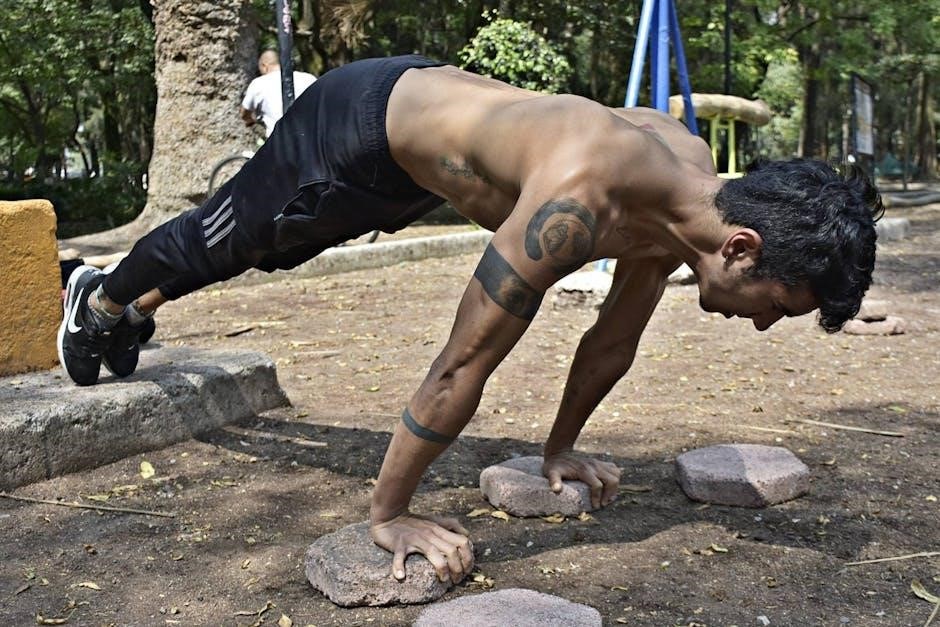
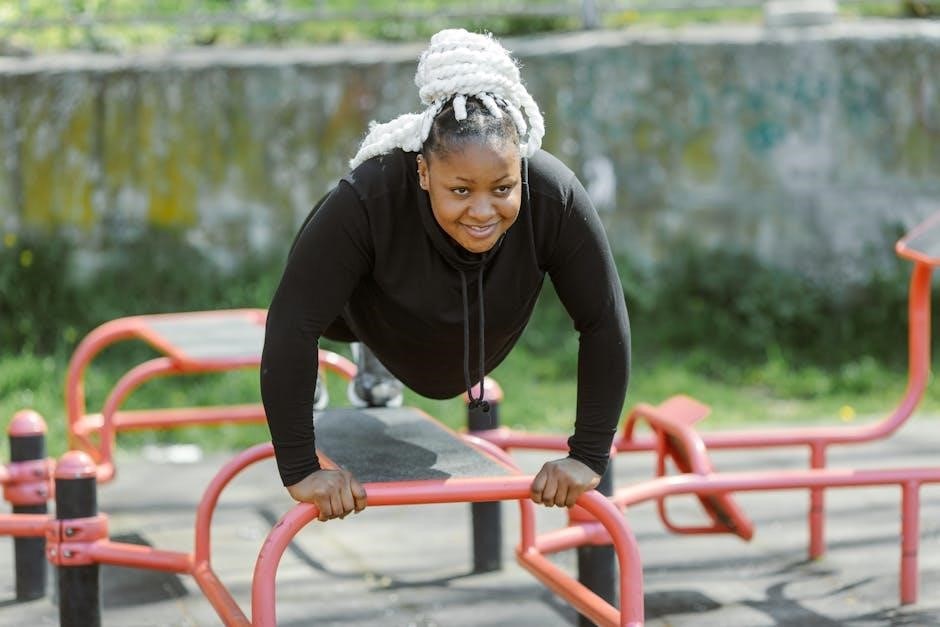
Push-ups are a cornerstone calisthenics exercise‚ building upper body strength. Begin with wall push-ups‚ then progress to knee push-ups to build foundational strength. Standard push-ups follow‚ focusing on maintaining a straight line from head to heels.
Variations include wide-grip push-ups targeting the chest‚ close-grip (diamond) push-ups emphasizing triceps‚ and decline push-ups increasing upper chest activation. For progression‚ elevate your feet to increase difficulty.

Advanced variations include archer push-ups‚ one-arm push-ups (assisted initially)‚ and plyometric (explosive) push-ups. Prioritize controlled movements and proper form throughout each progression to maximize results and prevent injury. Remember to listen to your body!
Squats: Form and Technique
Squats are fundamental for lower body strength and overall athleticism. Begin with your feet shoulder-width apart‚ toes slightly outward. Initiate the movement by hinging at the hips‚ as if sitting back into a chair‚ keeping your back straight and core engaged.
Descend until your thighs are parallel to the ground‚ or as low as your mobility allows‚ maintaining a neutral spine. Ensure your knees track in line with your toes‚ avoiding inward collapse. Drive through your heels to return to the starting position‚ squeezing your glutes at the top.
Variations include bodyweight squats‚ jump squats for explosiveness‚ and pistol squats (single-leg) for advanced strength. Focus on controlled movements and proper form to maximize benefits and minimize injury risk.
Planks: Core Engagement and Stability
Planks are an exceptional exercise for building core strength and stability‚ crucial for almost all calisthenic movements. Begin in a push-up position‚ but instead of resting on your hands‚ lower onto your forearms‚ keeping your elbows directly beneath your shoulders.
Maintain a straight line from head to heels‚ engaging your core‚ glutes‚ and legs. Avoid letting your hips sag or rise; focus on keeping your body rigid and stable. Breathe deeply and consistently throughout the exercise.
Variations include forearm planks‚ high planks (on hands)‚ and side planks for oblique engagement. Start with shorter holds (20-30 seconds) and gradually increase the duration as your core strength improves. Proper form is paramount!
The Calisthenics Workout Plan
Now‚ let’s dive into structured workouts! This section details progressive routines for beginner‚ intermediate‚ and advanced levels‚ maximizing your gains efficiently.
Beginner Workout (Weeks 1-4)
Welcome to the foundational phase! These initial four weeks focus on building a solid base of strength and proper form. Consistency is key during this period‚ prioritizing quality over quantity. Don’t be discouraged if you can’t perform many repetitions initially; gradual progression is the goal. This phase establishes neuromuscular connections and prepares your body for more challenging exercises. Remember to listen to your body and rest when needed. Proper form prevents injuries and ensures you’re effectively targeting the intended muscle groups. Focus on mastering the fundamental movements before increasing the difficulty. This will set you up for long-term success and sustainable gains. Embrace the process and enjoy the journey towards a stronger‚ fitter you!
Workout Schedule & Rep Ranges
For weeks 1-4‚ aim for three workouts per week‚ with rest days in between to allow for muscle recovery. A sample schedule could be Monday‚ Wednesday‚ and Friday. Each workout should include a warm-up‚ the exercise breakdown (detailed below)‚ and a cool-down. Rep ranges will be relatively low to focus on form. Perform 3 sets of 8-12 repetitions for each exercise. If you can easily complete 12 reps with good form‚ slightly increase the difficulty by exploring exercise variations. Prioritize controlled movements throughout each set. Rest for 60-90 seconds between sets. Adjust the schedule based on your individual recovery needs and listen to your body. Don’t push through pain; modify or rest if necessary. Consistency is paramount!
Exercise Breakdown: Beginner Level
Begin with foundational movements. Perform 3 sets of each exercise‚ aiming for 8-12 repetitions with proper form. Knee Push-Ups: Modify standard push-ups by keeping your knees on the ground. Incline Push-Ups: Use a wall or elevated surface to reduce difficulty. Squats: Focus on maintaining a straight back and controlled descent. Assisted Squats: Use a chair for support if needed. Plank: Hold for 30-60 seconds‚ maintaining a straight line from head to heels. Crunches: Engage your core and avoid pulling on your neck. Bird Dog: Improves core stability and balance; 10 reps per side. Remember to prioritize form over quantity. Rest 60-90 seconds between sets.
Intermediate Workout (Weeks 5-8)
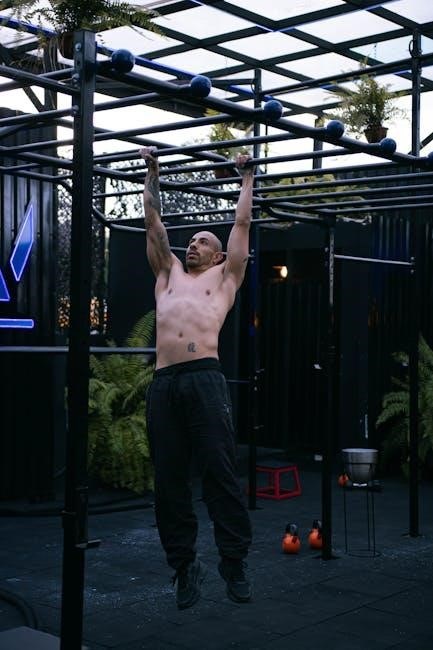
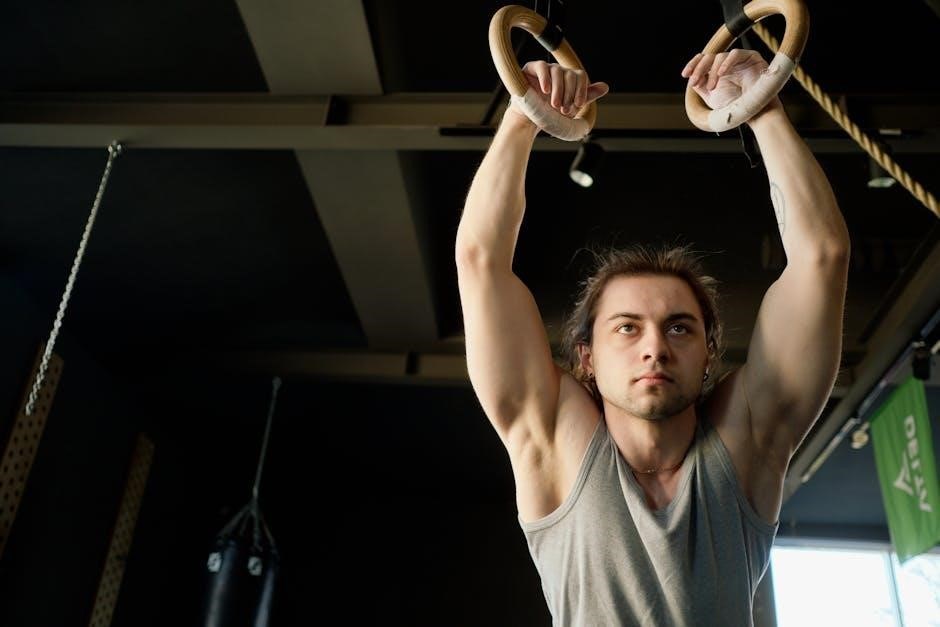
Progress to more challenging variations‚ increasing volume and intensity. Perform 3-4 sets of each exercise‚ aiming for 10-15 repetitions. Standard Push-Ups: Focus on full range of motion and controlled descent. Diamond Push-Ups: Targets triceps; maintain a diamond shape with your hands. Lunges: Alternate legs‚ ensuring your front knee doesn’t extend past your toes. Pistol Squat Progression: Practice assisted pistol squats using a support. Plank Variations: Incorporate shoulder taps or leg lifts. Hanging Knee Raises: Strengthens lower abs; use a sturdy pull-up bar. Superman: Strengthens lower back; 15 reps. Rest 60-75 seconds between sets.

Follow this structured schedule for optimal results. Monday: Upper Body (3 sets of 8-12 reps). Tuesday: Lower Body & Core (3 sets of 10-15 reps). Wednesday: Rest or Active Recovery (light cardio). Thursday: Full Body (3 sets of 8-12 reps). Friday: Core & Flexibility (3 sets of 15-20 reps). Saturday: Active Recovery or Rest. Sunday: Complete Rest. Rep Ranges: Adjust based on your ability; prioritize form over quantity. If you can easily exceed the upper rep range‚ increase difficulty. Listen to your body and don’t push through pain. Progressive overload is key – gradually increase reps‚ sets‚ or difficulty each week.
Exercise Breakdown: Intermediate Level
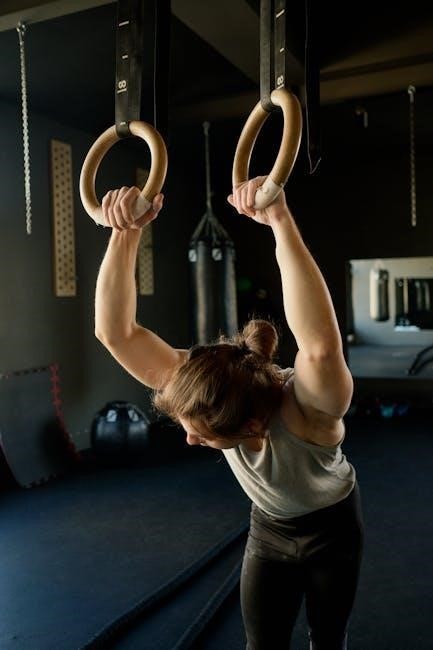
Elevate your training with these challenging exercises. Push-Ups: Diamond Push-Ups (3 sets of 8-12 reps)‚ Decline Push-Ups (3 sets of 10-15 reps). Squats: Pistol Squats (assisted if needed‚ 3 sets of 5-8 reps per leg)‚ Jump Squats (3 sets of 10-12 reps). Planks: Plank with Shoulder Taps (3 sets of 10-15 reps per side)‚ Side Plank with Hip Dip (3 sets of 12-15 reps per side). Pull-Ups: Assisted Pull-Ups (3 sets of as many reps as possible)‚ Chin-Ups (3 sets of 6-10 reps). Dips: Bench Dips (3 sets of 10-15 reps). Focus on controlled movements and proper form throughout each exercise. Prioritize quality over quantity for maximum gains.
Advanced Workout (Weeks 9+)
Unleash your full potential with this demanding routine. Push-Ups: One-Arm Push-Up progressions (3 sets of as many reps as possible per arm)‚ Handstand Push-Ups (against a wall‚ 3 sets of 5-8 reps). Squats: Pistol Squats (unassisted‚ 3 sets of 8-10 reps per leg)‚ Shrimp Squats (3 sets of 5-8 reps per leg). Planks: Weighted Plank (3 sets‚ hold for 60-90 seconds)‚ Dragon Flags (3 sets of 5-8 reps). Pull-Ups: Muscle-Ups (3 sets of as many reps as possible)‚ Weighted Pull-Ups (3 sets of 6-8 reps). Dips: Weighted Dips (3 sets of 8-12 reps). Maintain strict form and progressively increase difficulty.
Follow this schedule for optimal results: Monday – Upper Body (3 sets of 8-12 reps)‚ Wednesday – Lower Body (3 sets of 10-15 reps)‚ Friday – Core & Full Body (3 sets of 15-20 reps for core‚ 3 sets of 8-12 for full body). Rest days are crucial; incorporate active recovery like light cardio or stretching on Tuesdays‚ Thursdays‚ and weekends. Adjust rep ranges based on your ability – aim for challenging sets where the last few reps are difficult but maintain proper form. Prioritize quality over quantity. Progressively overload by increasing reps‚ sets‚ or difficulty of exercises each week. Listen to your body and adjust as needed!
Exercise Breakdown: Advanced Level
For seasoned calisthenics athletes‚ this level demands mastery. Include exercises like one-arm push-ups (3 sets of 5-8 reps per side)‚ pistol squats (3 sets of 8-12 reps per leg)‚ front levers (3 sets‚ hold for as long as possible with good form)‚ handstand push-ups (3 sets of 5-10 reps)‚ and muscle-ups (3 sets of 3-5 reps). Incorporate dynamic movements like plyometric push-ups and advanced core work such as dragon flags. Focus on explosive power and controlled movements. Prioritize proper form to prevent injury. Consider adding weighted calisthenics using a weight vest or dip belt for increased challenge. Remember to warm up thoroughly and cool down effectively.

Cool-down and Recovery
Prioritize post-workout recovery with stretching and proper nutrition; allowing muscles to rebuild and adapt‚ maximizing gains and minimizing soreness effectively.
Stretching Routine (5-10 Minutes)
Following each calisthenics session‚ dedicate 5-10 minutes to a comprehensive stretching routine. This is crucial for improving flexibility‚ reducing muscle soreness‚ and preventing injuries. Begin with dynamic stretches like arm circles and leg swings to increase blood flow. Then‚ transition into static stretches‚ holding each for 30 seconds.
Focus on major muscle groups worked during your workout. Include stretches for your chest (doorway stretch)‚ shoulders (cross-body arm stretch)‚ triceps (overhead triceps stretch)‚ back (cat-cow stretch)‚ hamstrings (seated toe touch)‚ quads (standing quad stretch)‚ and calves (standing calf stretch). Remember to breathe deeply and avoid bouncing.
Consistent stretching enhances range of motion and promotes faster recovery‚ allowing you to progress safely and effectively in your calisthenics journey. Don’t skip this vital component!
Nutrition for Calisthenics
Fueling your body correctly is paramount for optimal calisthenics performance and recovery. Prioritize a diet rich in whole‚ unprocessed foods. Protein is essential for muscle repair and growth – aim for 0.8-1 gram per pound of bodyweight. Complex carbohydrates‚ like sweet potatoes and brown rice‚ provide sustained energy for workouts.
Healthy fats‚ found in avocados and nuts‚ support hormone production and overall health. Hydration is also key; drink plenty of water throughout the day. Consider timing your nutrient intake around your workouts – a pre-workout snack with carbs and a post-workout meal with protein and carbs.
Avoid excessive sugar‚ processed foods‚ and unhealthy fats‚ as these can hinder your progress. A balanced diet complements your training‚ maximizing results and well-being;
Preventing Injuries in Calisthenics
Injury prevention is crucial for long-term calisthenics success. Proper form is non-negotiable; prioritize technique over repetitions. Always begin with a thorough warm-up to prepare your muscles and joints. Listen to your body and don’t push through pain – rest and recovery are vital.
Progress gradually‚ increasing intensity and volume incrementally to avoid overloading your system. Incorporate mobility work and stretching into your routine to maintain flexibility and range of motion. Strengthen supporting muscles to enhance joint stability.
Consider using proper equipment‚ like mats‚ and ensure a safe training environment. If you’re new to calisthenics‚ seeking guidance from a qualified instructor can significantly reduce your risk of injury.